
PVD Vacuum Plating for Stainless Steel Jewelry
PVD vacuum plating is the reason a steel bracelet can hold a gold tone through a summer of daily wear without the flaking that ruins a wet-plated piece. It is one of the 8 factory steps, it sits after polishing and before final QC, and it is quoted inside a 25–35 day sampling window rather than as a separate service. Below is what the process changes, and how packaging and minimums follow from it.

Key takeaways
- PVD vacuum plating is used on stainless steel; silver and brass take multi-layer electroplating plus anti-tarnish e-coating.
- The plating step is the sixth of 8 factory steps, with only inspection and packing after it.
- Stainless steel orders start at 100–150 pcs by style, the highest published minimum.
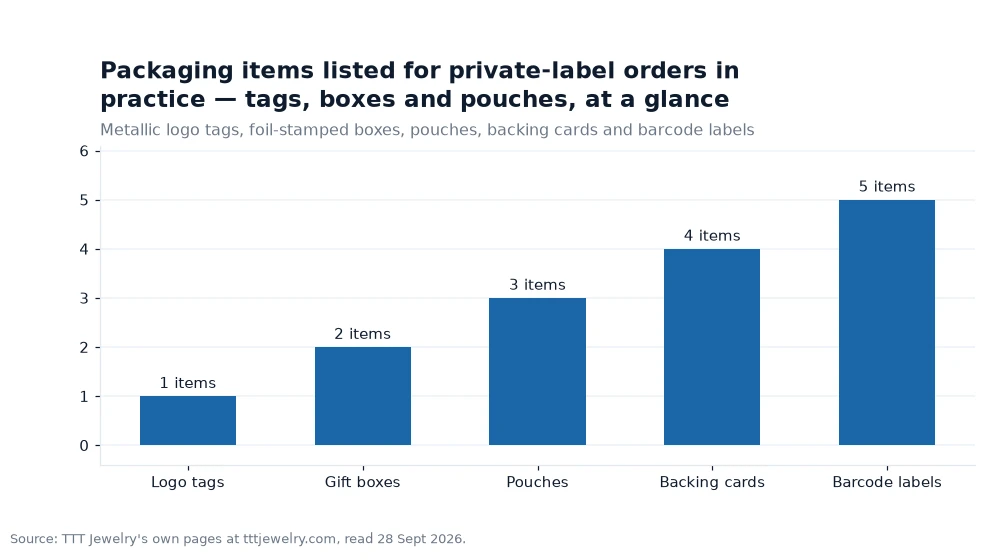
- Private-label orders can carry 5 packaging components, from logo tags to barcode labels.
What happens inside a vacuum chamber
Wet electroplating builds a metal layer out of a chemical bath: the piece is racked, dipped, rinsed and dried, and the coating grows out of solution. PVD is a vacuum process. Material is vaporised and deposited onto the surface in a sealed chamber, so there is no bath chemistry to drag between racks and no rinse water to dry out of a hollow link. For stainless steel, which is already corrosion resistant, the coat is there for colour and surface rather than for protection.
That distinction shapes the order of work. Because the coat is deposited rather than grown, the surface it lands on decides the result, which is why high-gloss polishing and the brushed or textured surface art step come before plating in the published eight-step sequence. A scratch at the polishing step does not disappear in the chamber; it is coated along with everything else.
Why the plating step is a point of no return
Look at where plating sits in the sequence: concept design, prototyping, sprue cutting, polishing, surface art, plating, final QC, delivery. Two steps follow it. There is no bench work after the chamber — no soldering, no filing, no wheel. A design change requested after plating therefore means either a re-run through the chamber or a piece scrapped, which is the practical argument for settling the finish at the CAD stage.
The CAD stage is deliberately short for exactly this reason. 3D CAD modelling is published at under 48 hours, and it returns a technical drawing plus renderings for dimensional approval. Getting the finish question answered on screen is cheap; getting it answered after the chamber is not.
Building the private-label spec sheet
| Input | Published option | Where it is decided |
|---|---|---|
| Base material | Stainless steel, with 925 sterling silver and artisan eco-brass as the alternatives | CAD stage |
| Finish | PVD vacuum plating on steel; multi-layer 14K / 18K / 24K gold and rhodium on other metals | Sample approval |
| Hallmark and logo | 316L hallmark and laser-engraved brand mark | Sampling |
| Packaging | Logo tags, gift boxes, pouches, backing cards, barcode labels | Before final QC |
| MOQ | 100–150 pcs by style for stainless steel | Enquiry |
Ask a wholesale stainless steel jewelry factory to name the mark on the piece before the sample is approved. A spec sheet that leaves the finish to the last minute costs more than one that names it early. The same is true of the hallmark: 316L for steel, S925 for silver, 18KGP for gold-plated pieces, applied by laser engraving in the same pass as the brand's own logo. Writing the mark into the brief costs nothing and prevents a shipment that carries another brand's answer to the same question.
Worked example: packaging five components across a 100-piece run
Take a steel design at the published 100–150 piece minimum and give it the full packaging list — logo tags, gift boxes, pouches, backing cards and barcode labels. That is five components per unit, so the packing bench handles 100 × 5 = 500 individual items at the bottom of the band and 150 × 5 = 750 at the top, on top of the jewellery itself.
Two conclusions follow. First, packaging is a second purchase order in all but name, and it should be specified at the same time as the finish rather than after the QC pass. Second, the packing stage is the last of the eight steps, so a late change to a gift box does not affect the plating chamber but does affect the ship date. Repairing a packaging decision after final QC is the slowest way to correct a mistake in the whole sequence.
The two published grades separate at the bonding step rather than at the chamber. Adhesion is rated optimal on 316L, which carries 2–3% molybdenum and is published as 100% waterproof, and reliable on 304, the cost-effective grade built for high-volume wholesale and fast fashion. Both run through the same vacuum-plating step; what changes is how well the deposited layer grips. If a piece will be worn in a pool, the grade belongs in the same brief as the finish.
Compliance paperwork behind a plated steel order
Three documents matter when a retailer asks about a plated piece. REACH limits on lead, cadmium and nickel, a BSCI audit and the ISO 9001:2015 standard, cadmium and nickel, and the plating claims sit under it. None of the three is a certificate you can paste into a listing; each one tells you what to request when a supplier makes a claim.
Finish options are gold at 14K, 18K or 24K with and rhodium, protected by anti-tarnish e-coating on silver and brass and PVD on stainless steel.
Frequently asked questions
Does PVD plating wear off a steel ring?
Every coating is a surface layer, so abrasive contact will eventually affect it. What PVD changes is the failure mode: it does not flake the way a poorly bonded wet-plated coat can, and it is applied to steel, which does not tarnish underneath it.
Can steel and brass pieces share one sample?
No. The two metals use different plating routes — PVD vacuum plating for stainless steel, multi-layer electroplating with anti-tarnish e-coating for brass — so each material takes its own master sample and its own minimum.
How long before a plated sample is in my hand?
The published window is 25–35 days for the master sample and 3–4 weeks for mass production, after a 3D CAD stage that returns in under 48 hours for approval.
Questions to settle before a steel order goes out
Ask three questions before you commit: which plating route the metal uses, where plating sits in the production sequence, and what happens to a piece that fails inspection at 100% QC. A supplier who can answer all three is describing a process it owns rather than a catalogue it forwards. TTT Jewelry publishes the eight steps, the plating options and the packaging list on its own pages, which makes the three answers easy to check. Worth pairing with the OEM and ODM routes if you are arriving with your own CAD files, and with the questions buyers ask most if this is a first production order.
The details quoted above — the PVD plating route with the 316L versus 304 comparison and the 100–150 pcs stainless steel floor — trace back to the supplier's own site on tttjewelry.com's own pages, dated 28 Sept 2026. The chart's relative scale is my own working — the site supplies the inputs only[1].